This is a list of the bird species recorded in Kenya. The avifauna of Kenya included a total of 1164 confirmed species as of October 2024. Of them, 11 are endemic, and 4 have been introduced by humans. An additional three species are considered "hypothetical" (see below) and are not included in the count. Unless otherwise noted, the list is that of Avibase.
This list's taxonomic treatment (designation and sequence of orders, families and species) and nomenclature (English and scientific names) are those of The Clements Checklist of Birds of the World, 2022 edition.
The following tags highlight several categories of occurrence other than regular migrants and non-endemic residents. The notes of population status are from the IUCN Red List of Threatened Species, and apply to the world-wide population except for endemics.
- (A) Accidental - a species that rarely or accidentally occurs in Kenya (also called a vagrant)
- (E) Endemic - a species endemic to Kenya
- (I) Introduced - a species introduced to Kenya as a consequence, direct or indirect, of human actions
- (H) Hypothetical - a species recorded but not confirmed in Kenya
Ostriches
Order: Struthioniformes Family: Struthionidae
The ostriches are flightless birds native to Africa. They are the largest living species of bird and are distinctive in appearance, with a long neck and legs and the ability to run at high speeds.
- Common ostrich, Struthio camelus
- Somali ostrich, Struthio molybdophanes (vulnerable)
Ducks, geese, and waterfowl
Order: Anseriformes Family: Anatidae
Anatidae includes the ducks and most duck-like waterfowl, such as geese and swans. These birds are adapted to an aquatic existence with webbed feet, flattened bills, and feathers that are excellent at shedding water due to an oily coating.
Guineafowl
Order: Galliformes Family: Numididae
Guineafowl are a group of African, seed-eating, ground-nesting birds that resemble partridges, but with featherless heads and spangled grey plumage.
- Helmeted guineafowl, Numida meleagris
- Vulturine guineafowl, Acryllium vulturinum
- Eastern crested guineafowl, Guttera pucherani
- Western crested guineafowl, Guttera verreauxi
New World quail
Order: Galliformes Family: Odontophoridae
Despite their family's common name, this species and one other are native to Africa.
- Stone partridge, Ptilopachus petrosus
Pheasants, grouse, and allies
Order: Galliformes Family: Phasianidae
The Phasianidae are a family of terrestrial birds which consists of quails, partridges, snowcocks, francolins, spurfowls, tragopans, monals, pheasants, peafowls, and jungle fowls. In general, they are plump (although they vary in size) and have broad, relatively short wings.
Flamingos
Order: Phoenicopteriformes Family: Phoenicopteridae
Flamingos are gregarious wading birds, usually 3 to 5 feet (0.9 to 1.5 m) tall, found in both the Western and Eastern Hemispheres. Flamingos filter-feed on shellfish and algae. Their oddly shaped beaks are specially adapted to separate mud and silt from the food they consume and, uniquely, are used upside-down.
- Greater flamingo, Phoenicopterus roseus
- Lesser flamingo, Phoeniconaias minor (near-threatened)
Grebes
Order: Podicipediformes Family: Podicipedidae
Grebes are small to medium-large freshwater diving birds. They have lobed toes and are excellent swimmers and divers. Their feet are placed far back on the body, making them quite ungainly on land.
- Little grebe, Tachybaptus ruficollis
- Great crested grebe, Podiceps cristatus
- Eared grebe, Podiceps nigricollis
Pigeons and doves
Order: Columbiformes Family: Columbidae
Pigeons and doves are stout-bodied birds with short necks and short slender bills with a fleshy cere.
Sandgrouse
Order: Pterocliformes Family: Pteroclidae
Sandgrouse have small, pigeon-like heads and necks, but sturdy compact bodies. They have long pointed wings and sometimes tails and a fast direct flight. Flocks fly to watering holes at dawn and dusk. Their legs are feathered down to the toes.
- Chestnut-bellied sandgrouse, Pterocles exustus
- Yellow-throated sandgrouse, Pterocles gutturalis
- Black-faced sandgrouse, Pterocles decoratus
- Lichtenstein's sandgrouse, Pterocles lichtensteinii
- Four-banded sandgrouse, Pterocles quadricinctus
Bustards
Order: Otidiformes Family: Otididae
Bustards are large terrestrial birds mainly associated with dry open country and steppes in the Old World. They are omnivorous and nest on the ground. They walk steadily on strong legs and big toes, pecking for food as they go. They have long broad wings with "fingered" wingtips and striking patterns in flight. Many have interesting mating displays.
- Arabian bustard, Ardeotis arabs (A) (near-threatened)
- Kori bustard, Ardeotis kori (near-threatened)
- Denham's bustard, Neotis denhami (near-threatened)
- Heuglin's bustard, Neotis heuglinii
- White-bellied bustard, Eupodotis senegalensis
- Buff-crested bustard, Lophotis gindiana
- Black-bellied bustard, Lissotis melanogaster
- Hartlaub's bustard, Lissotis hartlaubii
Turacos
Order: Musophagiformes Family: Musophagidae
The turacos, plantain eaters, and go-away-birds make up the family Musophagidae. They are medium-sized arboreal birds. The turacos and plantain-eaters are brightly colored, usually blue, green, or purple. The go-away-birds are mostly gray and white.
- Great blue turaco, Corythaeola cristata
- Schalow's turaco, Tauraco schalowi
- Black-billed turaco, Tauraco schuettii
- White-crested turaco, Tauraco leucolophus
- Fischer's turaco, Tauraco fischeri (near-threatened)
- Hartlaub's turaco, Tauraco hartlaubi
- Purple-crested turaco, Tauraco porphyreolophus
- Ross's turaco, Musophaga rossae
- Bare-faced go-away-bird, Corythaixoides personatus
- White-bellied go-away-bird, Corythaixoides leucogaster
- Eastern plantain-eater, Crinifer zonurus
Cuckoos
Order: Cuculiformes Family: Cuculidae
The family Cuculidae includes cuckoos, roadrunners, and anis. These birds are of variable size with slender bodies, long tails, and strong legs. The Old World cuckoos are brood parasites.
Nightjars and allies
Order: Caprimulgiformes Family: Caprimulgidae
Nightjars are medium-sized nocturnal birds that usually nest on the ground. They have long wings, short legs, and very short bills. Most have small feet, of little use for walking, and long pointed wings. Their soft plumage is camouflaged to resemble bark or leaves.
Swifts
Order: Caprimulgiformes Family: Apodidae
Swifts are small birds which spend the majority of their lives flying. They have very short legs and never settle voluntarily on the ground, perching instead only on vertical surfaces. Many swifts have long swept-back wings which resemble a crescent or boomerang.
Flufftails
Order: Gruiformes Family: Sarothruridae
The flufftails are a small family of ground-dwelling birds found only in Madagascar and sub-Saharan Africa.
- White-spotted flufftail, Sarothrura pulchra
- Buff-spotted flufftail, Sarothrura elegans
- Red-chested flufftail, Sarothrura rufa
- Streaky-breasted flufftail, Sarothrura boehmi
- Striped flufftail, Sarothrura affinis
Rails, gallinules, and coots
Order: Gruiformes Family: Rallidae
Rallidae is a large family of small to medium-sized birds which includes the rails, crakes, coots, and gallinules. Typically they inhabit dense vegetation in damp environments near lakes, swamps, or rivers. In general they are shy and secretive birds, making them difficult to observe. Most species have strong legs and long toes which are well adapted to soft uneven surfaces. They tend to have short, rounded wings and to be weak fliers.
- African rail, Rallus caerulescens
- Corn crake, Crex crex
- African crake, Crex egregia
- Spotted crake, Porzana porzana
- Lesser moorhen, Paragallinula angulata
- Eurasian moorhen, Gallinula chloropus
- Red-knobbed coot, Fulica cristata
- Allen's gallinule, Porphyrio alleni
- African swamphen, Porphyrio madagascariensis
- Striped crake, Amaurornis marginalis
- Black crake, Zapornia flavirostra
- Little crake, Zapornia parva (H)
- Baillon's crake, Zapornia pusilla
Finfoots
Order: Gruiformes Family: Heliornithidae
Heliornithidae is a small family of tropical birds with webbed lobes on their feet similar to those of grebes and coots.
- African finfoot, Podica senegalensis
Cranes
Order: Gruiformes Family: Gruidae
Cranes are large, long-legged, and long-necked birds. Unlike the similar-looking but unrelated herons, cranes fly with necks outstretched, not pulled back. Most have elaborate and noisy courting displays or "dances".
- Gray crowned-crane, Balearica regulorum (endangered)
- Black crowned-crane, Balearica pavonina (vulnerable)
- Demoiselle crane, Anthropoides virgo (A)
- Common crane, Grus grus (A)
Thick-knees
Order: Charadriiformes Family: Burhinidae
The thick-knees are a group of waders found worldwide within the tropical zone, with some species also breeding in temperate Europe and Australia. They are medium to large waders with strong black or yellow-black bills, large yellow eyes, and cryptic plumage. Despite being classed as waders, most species have a preference for arid or semi-arid habitats.
- Water thick-knee, Burhinus vermiculatus
- Eurasian thick-knee, Burhinus oedicnemus (A)
- Senegal thick-knee, Burhinus senegalensis
- Spotted thick-knee, Burhinus capensis
Egyptian plover
Order: Charadriiformes Family: Pluvianidae
The Egyptian plover is found across equatorial Africa and along the Nile River.
- Egyptian plover, Pluvianus aegyptius (A)
Stilts and avocets
Order: Charadriiformes Family: Recurvirostridae
Recurvirostridae is a family of large wading birds which includes the avocets and stilts. The avocets have long legs and long up-curved bills. The stilts have extremely long legs and long, thin, straight bills.
- Black-winged stilt, Himantopus himantopus
- Pied avocet, Recurvirostra avosetta
Oystercatchers
Order: Charadriiformes Family: Haematopodidae
The oystercatchers are large and noisy plover-like birds, with strong bills used for smashing or prising open molluscs.
- Eurasian oystercatcher, Haematopus ostralegus
Plovers and lapwings
Order: Charadriiformes Family: Charadriidae
The family Charadriidae includes the plovers, dotterels, and lapwings. They are small to medium-sized birds with compact bodies, short thick necks, and long, usually pointed, wings. They are found in open country worldwide, mostly in habitats near water.
Painted-snipes
Order: Charadriiformes Family: Rostratulidae
Painted-snipes are short-legged, long-billed birds similar in shape to the true snipes, but more brightly colored.
- Greater painted-snipe, Rostratula benghalensis
Jacanas
Order: Charadriiformes Family: Jacanidae
The jacanas are a family of waders that are found throughout the tropics. They are identifiable by their huge feet and claws which enable them to walk on floating vegetation in the shallow lakes that are their preferred habitat.
- Lesser jacana, Microparra capensis
- African jacana, Actophilornis africanus
Sandpipers and allies
Order: Charadriiformes Family: Scolopacidae
Scolopacidae is a large diverse family of small to medium-sized shorebirds including the sandpipers, curlews, godwits, shanks, tattlers, woodcocks, snipes, dowitchers, and phalaropes. The majority of these species eat small invertebrates picked out of the mud or soil. Variation in length of legs and bills enables multiple species to feed in the same habitat, particularly on the coast, without direct competition for food.
Buttonquails
Order: Charadriiformes Family: Turnicidae
The buttonquails are small, drab, running birds which resemble the true quails. The female is the brighter of the sexes and initiates courtship. The male incubates the eggs and tends the young.
- Small buttonquail, Turnix sylvaticus
- Black-rumped buttonquail, Turnix nanus
- Quail-plover, Ortyxelos meiffrenii
Crab-plover
Order: Charadriiformes Family: Dromadidae
The crab-plover is related to the waders. It resembles a plover but with very long grey legs and a strong heavy black bill similar to a tern's. It has black-and-white plumage, a long neck, partially webbed feet, and a bill designed for eating crabs.
- Crab-plover, Dromas ardeola
Pratincoles and coursers
Order: Charadriiformes Family: Glareolidae
Glareolidae is a family of wading birds comprising the pratincoles, which have short legs, long pointed wings, and long forked tails, and the coursers, which have long legs, short wings, and long, pointed bills which curve downwards.
- Cream-colored courser, Cursorius cursor (A)
- Somali courser, Cursorius somalensis
- Temminck's courser, Cursorius temminckii
- Double-banded courser, Smutsornis africanus
- Three-banded courser, Rhinoptilus cinctus
- Bronze-winged courser, Rhinoptilus chalcopterus
- Collared pratincole, Glareola pratincola
- Black-winged pratincole, Glareola nordmanni (A) (near-threatened)
- Madagascar pratincole, Glareola ocularis (vulnerable)
- Rock pratincole, Glareola nuchalis
Skuas and jaegers
Order: Charadriiformes Family: Stercorariidae
The family Stercorariidae are, in general, medium to large birds, typically with grey or brown plumage, often with white markings on the wings. They nest on the ground in temperate and arctic regions and are long-distance migrants.
- Brown skua, Stercorarius antarcticus (A)
- Pomarine jaeger, Stercorarius pomarinus
- Parasitic jaeger, Stercorarius parasiticus (A)
- Long-tailed jaeger, Stercorarius longicaudus (A)
Gulls, terns, and skimmers
Order: Charadriiformes Family: Laridae
Laridae is a family of medium to large seabirds, the gulls, kittiwakes, terns, and skimmers. Gulls are typically gray or white, often with black markings on the head or wings. They have stout, longish bills and webbed feet. Terns are a group of generally medium to large seabirds typically with gray or white plumage, often with black markings on the head. Most terns hunt fish by diving but some pick insects off the surface of fresh water. Terns are generally long-lived birds, with several species known to live in excess of 30 years. Skimmers are a small family of tropical tern-like birds. They have an elongated lower mandible which they use to feed by flying low over the water surface and skimming the water for small fish.
- Sabine's gull, Xema sabini (A)
- Slender-billed gull, Chroicocephalus genei
- Gray-hooded gull, Chroicocephalus cirrocephalus
- Black-headed gull, Chroicocephalus ridibundus
- Little gull, Hydrocoloeus minutus (A)
- Mediterranean gull, Ichthyaetus melanocephalus (A)
- White-eyed gull, Ichthyaetus leucophthalmus (A)
- Sooty gull, Ichthyaetus hemprichii
- Pallas's gull, Ichthyaetus ichthyaetus
- Common gull, Larus canus (A)
- Lesser black-backed gull, Larus fuscus
- Kelp gull, Larus dominicanus (A)
- Brown noddy, Anous stolidus
- Lesser noddy, Anous tenuirostris (A)
- Sooty tern, Onychoprion fuscatus
- Bridled tern, Onychoprion anaethetus
- Little tern, Sternula albifrons (A)
- Saunders's tern, Sternula saundersi
- Gull-billed tern, Gelochelidon nilotica
- Caspian tern, Hydroprogne caspia
- Black tern, Chlidonias niger (A)
- White-winged tern, Chlidonias leucopterus
- Whiskered tern, Chlidonias hybrida
- Roseate tern, Sterna dougallii
- Common tern, Sterna hirundo
- Arctic tern, Sterna paradisaea (A)
- White-cheeked tern, Sterna repressa
- Great crested tern, Thalasseus bergii
- Sandwich tern, Thalasseus sandvicensis
- Lesser crested tern, Thalasseus bengalensis
- African skimmer, Rynchops flavirostris (near-threatened)
Tropicbirds
Order: Phaethontiformes Family: Phaethontidae
Tropicbirds are slender white birds of tropical oceans, with exceptionally long central tail feathers. Their heads and long wings have black markings.
- White-tailed tropicbird, Phaethon lepturus
- Red-billed tropicbird, Phaethon aethereus (A)
- Red-tailed tropicbird, Phaethon rubricauda (A)
Albatrosses
Order: Procellariiformes Family: Diomedeidae
The albatrosses are among the largest of flying birds, and the great albatrosses of the genus Diomedea have the largest wingspans of any extant birds.
- White-capped albatross, Thalassarche cauta (A)
- Black-browed albatross, Thalassarche melanophris (A)
Southern storm-petrels
Order: Procellariiformes Family: Oceanitidae
The storm-petrels are the smallest seabirds, relatives of the petrels, feeding on planktonic crustaceans and small fish picked from the surface, typically while hovering. The flight is fluttering and sometimes bat-like. Until 2018, this family's species were included with the other storm-petrels in family Hydrobatidae.
- Wilson's storm-petrel, Oceanites oceanicus
- Black-bellied storm-petrel, Fregetta tropica (A)
Northern storm-petrels
Order: Procellariiformes Family: Hydrobatidae
Though the members of this family are similar in many respects to the southern storm-petrels, including their general appearance and habits, there are enough genetic differences to warrant their placement in a separate family.
- Leach's storm-petrel, Hydrobates leucorhous (A) (vulnerable)
- Matsudaira's storm-petrel, Hydrobates matsudairae (A) (vulnerable)
Shearwaters and petrels
Order: Procellariiformes Family: Procellariidae
The procellariids are the main group of medium-sized "true petrels", characterised by united nostrils with medium septum and a long outer functional primary.
- Southern giant-petrel, Macronectes giganteus (H)
- Cape petrel, Daption capense (A)
- Antarctic prion, Pachyptila desolata (A)
- Slender-billed prion, Pachyptila belcheri (A)
- Jouanin's petrel, Bulweria fallax (A) (near-threatened)
- White-chinned petrel, Procellaria aequinoctialis (A) (vulnerable)
- Wedge-tailed shearwater, Ardenna pacifica (A)
- Sooty shearwater, Ardenna grisea (A) (near-threatened)
- Tropical shearwater, Puffinus bailloni
- Persian shearwater, Puffinus persicus (A)
Storks
Order: Ciconiiformes Family: Ciconiidae
Storks are large, long-legged, long-necked wading birds with long, stout bills. Storks are mute, but bill-clattering is an important mode of communication at the nest. Their nests can be large and may be reused for many years. Many species are migratory.
- African openbill, Anastomus lamelligerus
- Black stork, Ciconia nigra
- Abdim's stork, Ciconia abdimii
- African woolly-necked stork, Ciconia microscelis
- White stork, Ciconia ciconia
- Saddle-billed stork, Ephippiorhynchus senegalensis
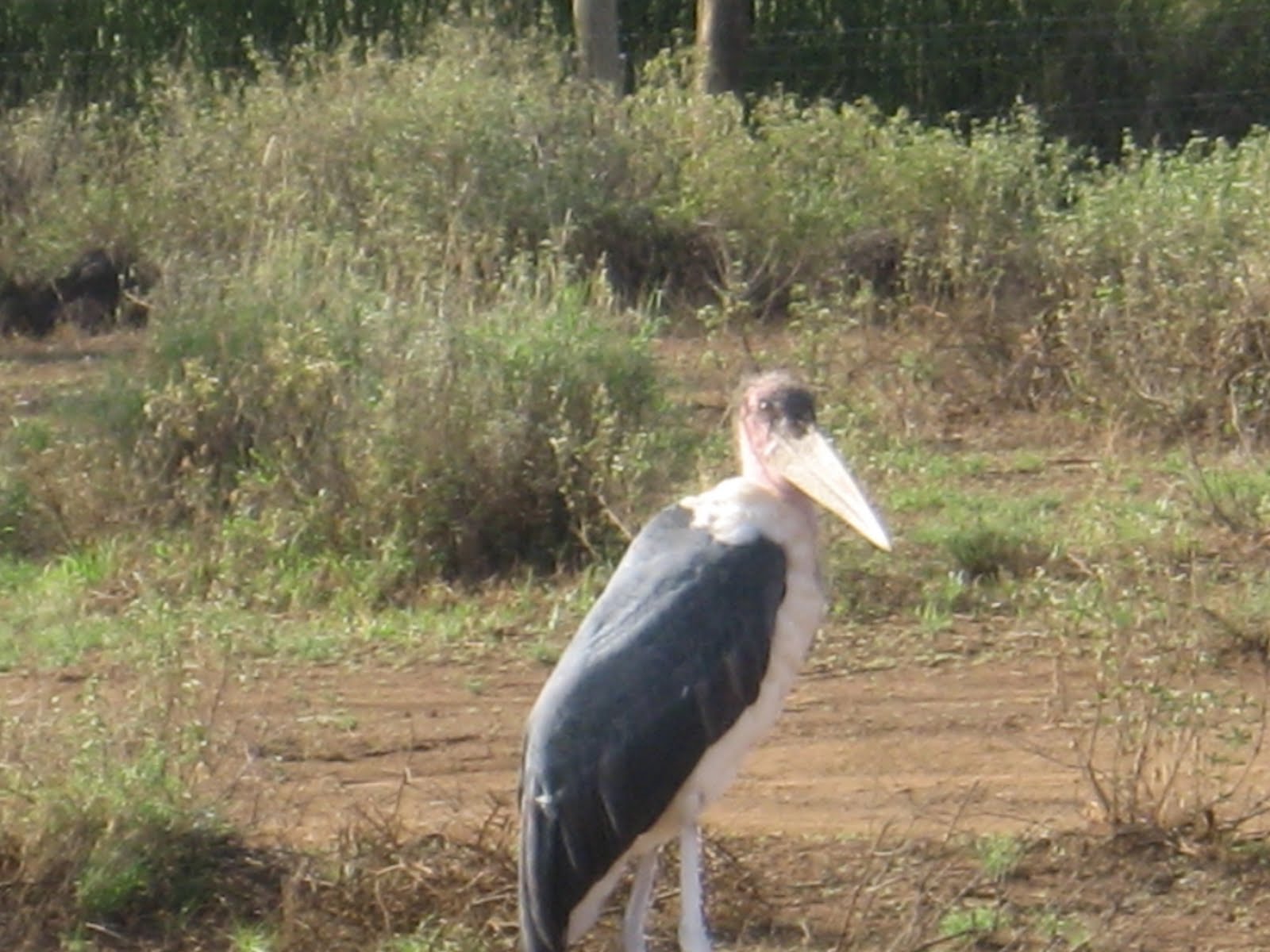
- Marabou stork, Leptoptilos crumenifer
- Yellow-billed stork, Mycteria ibis
Frigatebirds
Order: Suliformes Family: Fregatidae
Frigatebirds are large seabirds usually found over tropical oceans. They are large, black-and-white, or completely black, with long wings and deeply forked tails. The males have colored inflatable throat pouches. They do not swim or walk and cannot take off from a flat surface. Having the largest wingspan-to-body-weight ratio of any bird, they are essentially aerial, able to stay aloft for more than a week.
- Lesser frigatebird, Fregata ariel (A)
- Christmas Island frigatebird, Fregata andrewsi (A)
- Great frigatebird, Fregata minor (A)
Boobies and gannets
Order: Suliformes Family: Sulidae
The sulids comprise the gannets and boobies. Both groups are medium to large coastal seabirds that plunge-dive for fish.
- Masked booby, Sula dactylatra
- Brown booby, Sula leucogaster
- Red-footed booby, Sula sula (A)
Anhingas
Order: Suliformes Family: Anhingidae
Anhingas or darters are often called "snake-birds" because of their long thin neck, which gives a snake-like appearance when they swim with their bodies submerged. The males have black and dark-brown plumage, an erectile crest on the nape, and a larger bill than the female. The females have much paler plumage especially on the neck and underparts. The darters have completely webbed feet and their legs are short and set far back on the body. Their plumage is somewhat permeable, like that of cormorants, and they spread their wings to dry after diving.
- African darter, Anhinga rufa
Cormorants and shags
Order: Suliformes Family: Phalacrocoracidae
Phalacrocoracidae is a family of medium to large coastal, fish-eating seabirds that includes cormorants and shags. Plumage coloration varies, with the majority having mainly dark plumage, some species being black-and-white, and a few being colorful.
- Long-tailed cormorant, Microcarbo africanus
- Great cormorant, Phalacrocorax carbo
Pelicans
Order: Pelecaniformes Family: Pelecanidae
Pelicans are large water birds with a distinctive pouch under their beak. As with other members of the order Pelecaniformes, they have webbed feet with four toes.
- Great white pelican, Pelecanus onocrotalus
- Pink-backed pelican, Pelecanus rufescens
Shoebill
Order: Pelecaniformes Family: Balaenicipididae
The shoebill was formerly thought to be related to storks but is in the same order as pelicans. It derives its name from its massive shoe-shaped bill.
- Shoebill, Balaeniceps rex (A) (vulnerable)
Hamerkop
Order: Pelecaniformes Family: Scopidae
The hamerkop is a medium-sized bird with a long shaggy crest. The shape of its head with a curved bill and crest at the back is reminiscent of a hammer, hence its name. Its plumage is drab-brown all over.
- Hamerkop, Scopus umbretta
Herons, egrets, and bitterns
Order: Pelecaniformes Family: Ardeidae
The family Ardeidae contains the bitterns, herons, and egrets. Herons and egrets are medium to large wading birds with long necks and legs. Bitterns tend to be shorter necked and more wary. Members of Ardeidae fly with their necks retracted, unlike other long-necked birds such as storks, ibises and spoonbills.
Ibises and spoonbills
Order: Pelecaniformes Family: Threskiornithidae
Threskiornithidae is a family of large terrestrial and wading birds which includes the ibises and spoonbills. They have long, broad wings with 11 primary and about 20 secondary feathers. They are strong fliers and despite their size and weight, very capable soarers.
- Glossy ibis, Plegadis falcinellus
- African sacred ibis, Threskiornis aethiopicus
- Olive ibis, Bostrychia olivacea
- Hadada ibis, Bostrychia hagedash
- Eurasian spoonbill, Platalea leucorodia
- African spoonbill, Platalea alba
Secretarybird
Order: Accipitriformes Family: Sagittariidae
The secretary-bird is a bird of prey but is easily distinguished from other raptors by its long crane-like legs.
- Secretarybird, Sagittarius serpentarius (endangered)
Osprey
Order: Accipitriformes Family: Pandionidae
The family Pandionidae contains only one species, the osprey. The osprey is a medium-large raptor which is a specialist fish-eater with a worldwide distribution.
- Osprey, Pandion haliaetus
Hawks, eagles, and kites
Order: Accipitriformes Family: Accipitridae
Accipitridae is a family of birds of prey which includes hawks, eagles, kites, harriers, and Old World vultures. These birds have powerful hooked beaks for tearing flesh from their prey, strong legs, powerful talons, and keen eyesight.
Barn-owls
Order: Strigiformes Family: Tytonidae
Barn-owls are medium to large owls with large heads and characteristic heart-shaped faces. They have long strong legs with powerful talons.
- African grass-owl, Tyto capensis
- Western barn owl, Tyto alba
Owls
Order: Strigiformes Family: Strigidae
The typical owls are small to large solitary nocturnal birds of prey. They have large forward-facing eyes and ears, a hawk-like beak, and a conspicuous circle of feathers around each eye called a facial disk.
Mousebirds
Order: Coliiformes Family: Coliidae
The mousebirds are slender grayish or brown birds with soft, hairlike body feathers and very long thin tails. They are arboreal and scurry through the leaves like rodents in search of berries, fruit, and buds. They are acrobatic and can feed upside down. All species have strong claws and reversible outer toes. They also have crests and stubby bills.
- Speckled mousebird, Colius striatus
- White-headed mousebird, Colius leucocephalus
- Blue-naped mousebird, Urocolius macrourus
Trogons
Order: Trogoniformes Family: Trogonidae
The family Trogonidae includes trogons and quetzals. Found in tropical woodlands worldwide, they feed on insects and fruit, and their broad bills and weak legs reflect their diet and arboreal habits. Although their flight is fast, they are reluctant to fly any distance. Trogons have soft, often colorful, feathers with distinctive male and female plumage.
- Narina trogon, Apaloderma narina
- Bar-tailed trogon, Apaloderma vittatum
Hoopoes
Order: Bucerotiformes Family: Upupidae
Hoopoes have black, white, and orangey-pink coloring with a large erectile crest on their head.
- Eurasian hoopoe, Upupa epops
Woodhoopoes and scimitarbills
Order: Bucerotiformes Family: Phoeniculidae
The woodhoopoes and scimitarbills are related to the hoopoes, ground-hornbills, and hornbills. They most resemble the hoopoes with their long curved bills, used to probe for insects, and short rounded wings. However, they differ in that they have metallic plumage, often blue, green, or purple, and lack an erectile crest.
- Green woodhoopoe, Phoeniculus purpureus
- Violet woodhoopoe, Phoeniculus damarensis
- Black-billed woodhoopoe, Phoeniculus somaliensis
- White-headed woodhoopoe, Phoeniculus bollei
- Common scimitarbill, Rhinopomastus cyanomelas
- Abyssinian scimitarbill, Rhinopomastus minor
Ground-hornbills
Order: Bucerotiformes Family: Bucorvidae
The ground-hornbills are terrestrial birds which feed almost entirely on insects, other birds, snakes, and amphibians.
- Abyssinian ground-hornbill, Bucorvus abyssinicus (vulnerable)
- Southern ground-hornbill, Bucorvus leadbeateri (vulnerable)
Hornbills
Order: Bucerotiformes Family: Bucerotidae
Hornbills are a group of birds whose bill is shaped like a cow's horn, but without a twist, sometimes with a casque on the upper mandible. Frequently, the bill is brightly colored.
- Crowned hornbill, Lophoceros alboterminatus
- Hemprich's hornbill, Lophoceros hemprichii
- African gray hornbill, Lophoceros nasutus
- Eastern yellow-billed hornbill, Tockus flavirostris
- Jackson's hornbill, Tockus jacksoni
- Von der Decken's hornbill, Tockus deckeni
- Northern red-billed hornbill, Tockus erythrorhynchus
- Silvery-cheeked hornbill, Bycanistes brevis
- Black-and-white-casqued hornbill, Bycanistes subcylindricus
- Trumpeter hornbill, Bycanistes bucinator
Kingfishers
Order: Coraciiformes Family: Alcedinidae
Kingfishers are medium-sized birds with large heads, long, pointed bills, short legs, and stubby tails.
- Half-collared kingfisher, Alcedo semitorquata
- Shining-blue kingfisher, Alcedo quadribrachys
- Malachite kingfisher, Corythornis cristatus
- African pygmy kingfisher, Ispidina picta
- Gray-headed kingfisher, Halcyon leucocephala
- Woodland kingfisher, Halcyon senegalensis
- Mangrove kingfisher, Halcyon senegaloides
- Blue-breasted kingfisher, Halcyon malimbica (A)
- Brown-hooded kingfisher, Halcyon albiventris
- Striped kingfisher, Halcyon chelicuti
- Collared kingfisher, Todiramphus chloris
- Giant kingfisher, Megaceryle maxima
- Pied kingfisher, Ceryle rudis
Bee-eaters
Order: Coraciiformes Family: Meropidae
The bee-eaters are a group of near passerine birds in the family Meropidae. Most species are found in Africa but others occur in southern Europe, Madagascar, Australia, and New Guinea. They are characterised by richly colored plumage, slender bodies, and usually elongated central tail feathers. All have long down-turned bills and pointed wings, which give them a swallow-like appearance when seen from afar.
- Blue-headed bee-eater, Merops muelleri
- White-fronted bee-eater, Merops bullockoides
- Little bee-eater, Merops pusillus
- Blue-breasted bee-eater, Merops variegatus
- Ethiopian bee-eater, Merops lafresnayii (A)
- Cinnamon-chested bee-eater, Merops oreobates
- Swallow-tailed bee-eater, Merops hirundineus (A)
- Somali bee-eater, Merops revoilii
- White-throated bee-eater, Merops albicollis
- Böhm's bee-eater, Merops boehmi (A)
- Blue-cheeked bee-eater, Merops persicus
- Madagascar bee-eater, Merops superciliosus
- European bee-eater, Merops apiaster
- Northern carmine bee-eater, Merops nubicus
- Southern carmine bee-eater, Merops nubicoides (A)
Rollers
Order: Coraciiformes Family: Coraciidae
Rollers resemble crows in size and build, but are more closely related to the kingfishers and bee-eaters. They share the colorful appearance of those groups with blues and browns predominating. The two inner front toes are connected, but the outer toe is not.
- European roller, Coracias garrulus
- Abyssinian roller, Coracias abyssinicus
- Lilac-breasted roller, Coracias caudatus
- Racket-tailed roller, Coracias spatulatus (A)
- Rufous-crowned roller, Coracias naevius
- Broad-billed roller, Eurystomus glaucurus
African barbets
Order: Piciformes Family: Lybiidae
The barbets are plump birds, with short necks and large heads. They get their name from the bristles which fringe their heavy bills. Most species are brightly colored.
Honeyguides
Order: Piciformes Family: Indicatoridae
Honeyguides are among the few birds that feed on wax. They are named for the greater honeyguide which leads traditional honey-hunters to bees' nests and, after the hunters have harvested the honey, feeds on the remaining contents of the hive.
- Cassin's honeyguide, Prodotiscus insignis
- Green-backed honeyguide, Prodotiscus zambesiae
- Wahlberg's honeyguide, Prodotiscus regulus
- Pallid honeyguide, Indicator meliphilus
- Least honeyguide, Indicator exilis
- Lesser honeyguide, Indicator minor
- Scaly-throated honeyguide, Indicator variegatus
- Greater honeyguide, Indicator indicator
Woodpeckers
Order: Piciformes Family: Picidae
Woodpeckers are small to medium-sized birds with chisel-like beaks, short legs, stiff tails, and long tongues used for capturing insects. Some species have feet with two toes pointing forward and two backward, while several species have only three toes. Many woodpeckers have the habit of tapping noisily on tree trunks with their beaks.
Falcons and caracaras
Order: Falconiformes Family: Falconidae
Falconidae is a family of diurnal birds of prey. They differ from hawks, eagles, and kites in that they kill with their beaks instead of their talons.
Old World parrots
Order: Psittaciformes Family: Psittaculidae
Characteristic features of parrots include a strong curved bill, an upright stance, strong legs, and clawed zygodactyl feet. Many parrots are vividly colored, and some are multi-colored. In size they range from 8 cm (3.1 in) to 1 m (3.3 ft) in length. Old World parrots are found from Africa east across south and southeast Asia and Oceania to Australia and New Zealand.
- Gray-headed lovebird, Agapornis canus (I)
- Red-headed lovebird, Agapornis pullarius
- Fischer's lovebird, Agapornis fischeri (near-threatened)
- Yellow-collared lovebird, Agapornis personatus (I)
African and New World parrots
Order: Psittaciformes Family: Psittacidae
Characteristic features of parrots include a strong curved bill, an upright stance, strong legs, and clawed zygodactyl feet. Many parrots are vividly colored, and some are multi-colored. In size they range from 8 cm (3.1 in) to 1 m (3.3 ft) in length. Most of the more than 150 species in this family are found in the New World.
- Gray parrot, Psittacus erithacus
- Red-fronted parrot, Poicephalus gulielmi
- Meyer's parrot, Poicephalus meyeri
- Brown-headed parrot, Poicephalus cryptoxanthus
- Red-bellied parrot, Poicephalus rufiventris
African and green broadbills
Order: Passeriformes Family: Calyptomenidae
The broadbills are small, brightly colored birds which feed on fruit and also take insects in flycatcher fashion, snapping their broad bills. Their habitat is canopies of wet forests.
- African broadbill, Smithornis capensis
Pittas
Order: Passeriformes Family: Pittidae
Pittas are medium-sized by passerine standards and are stocky, with fairly long, strong legs, short tails, and stout bills. Many are brightly colored. They spend the majority of their time on wet forest floors, eating snails, insects, and similar invertebrates.
- African pitta, Pitta angolensis
Cuckooshrikes
Order: Passeriformes Family: Campephagidae
The cuckooshrikes are small to medium-sized passerine birds. They are predominantly grayish with white and black, although some species are brightly colored.
- Gray cuckooshrike, Coracina caesia
- White-breasted cuckooshrike, Coracina pectoralis
- Black cuckooshrike, Campephaga flava
- Petit's cuckooshrike, Campephaga petiti
- Red-shouldered cuckooshrike, Campephaga phoenicea
- Purple-throated cuckooshrike, Campephaga quiscalina
Old World orioles
Order: Passeriformes Family: Oriolidae
The Old World orioles are colorful passerine birds which are not related to the similar-looking New World orioles.
- Eurasian golden oriole, Oriolus oriolus
- African golden oriole, Oriolus auratus
- Green-headed oriole, Oriolus chlorocephalus
- Western black-headed oriole, Oriolus brachyrhynchus
- African black-headed oriole, Oriolus larvatus
- Black-tailed oriole, Oriolus percivali
Wattle-eyes and batises
Order: Passeriformes Family: Platysteiridae
The wattle-eyes, or puffback flycatchers, are small stout passerine birds of the African tropics. They get their name from the brightly colored fleshy eye decorations found in most species in this group.
- Brown-throated wattle-eye, Platysteira cyanea
- Black-throated wattle-eye, Platysteira peltata
- Chestnut wattle-eye, Platysteira castanea
- Jameson's wattle-eye, Platysteira jamesoni
- Yellow-bellied wattle-eye, Platysteira concreta
- Short-tailed batis, Batis mixta
- Chinspot batis, Batis molitor
- Pale batis, Batis soror
- Gray-headed batis, Batis orientalis (A)
- Western black-headed batis, Batis erlangeri
- Eastern black-headed batis, Batis minor
- Pygmy batis, Batis perkeo
Vangas, helmetshrikes, and allies
Order: Passeriformes Family: Vangidae
The helmetshrikes are similar in build to the shrikes, but tend to be colorful species with distinctive crests or other head ornaments, such as wattles, from which they get their name.
- White helmetshrike, Prionops plumatus
- Gray-crested helmetshrike, Prionops poliolophus (near-threatened)
- Retz's helmetshrike, Prionops retzii
- Chestnut-fronted helmetshrike, Prionops scopifrons
- African shrike-flycatcher, Megabyas flammulatus
- Black-and-white shrike-flycatcher, Bias musicus
Bushshrikes and allies
Order: Passeriformes Family: Malaconotidae
Bushshrikes are similar in habits to shrikes, hunting insects and other small prey from a perch on a bush. Although similar in build to the shrikes, these tend to be either colorful species or largely black; some species are quite secretive.
Drongos
Order: Passeriformes Family: Dicruridae
The drongos are mostly black or dark gray in color, sometimes with metallic tints. They have long forked tails, and some Asian species have elaborate tail decorations. They have short legs and sit very upright when perched, like a shrike. They flycatch or take prey from the ground.
- Sharpe's drongo, Dicrurus sharpei
- Common square-tailed drongo, Dicrurus ludwigii
- Fork-tailed drongo, Dicrurus adsimilis
- Glossy-backed drongo, Dicrurus divaricatus
- Velvet-mantled drongo, Dicrurus modestus
Monarch flycatchers
Order: Passeriformes Family: Monarchidae
The monarch flycatchers are small to medium-sized insectivorous passerines which hunt by flycatching.
- African crested-flycatcher, Trochocercus cyanomelas
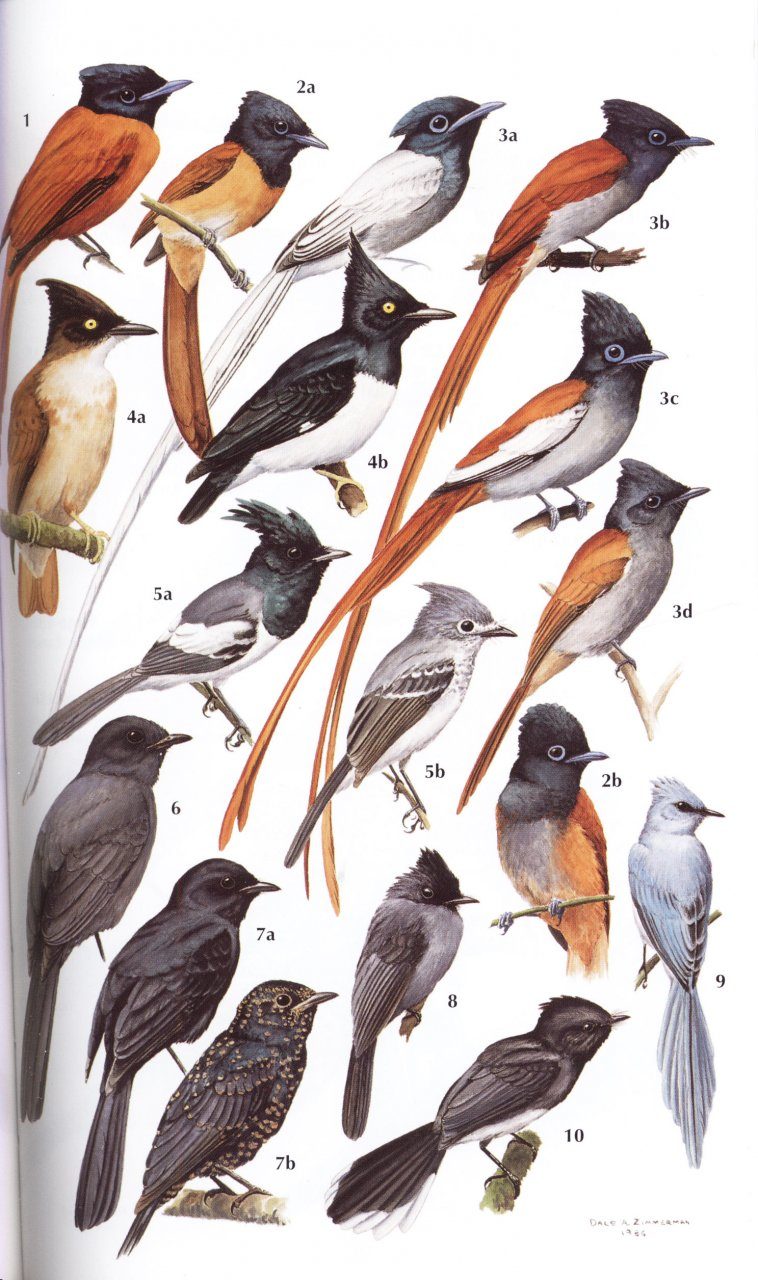
- Black-headed paradise-flycatcher, Terpsiphone rufiventer
- African paradise-flycatcher, Terpsiphone viridis
Shrikes
Order: Passeriformes Family: Laniidae
Shrikes are passerine birds known for their habit of catching other birds and small animals and impaling the uneaten portions of their bodies on thorns. A shrike's beak is hooked, like that of a typical bird of prey.
Crows, jays, and ravens
Order: Passeriformes Family: Corvidae
The family Corvidae includes crows, ravens, jays, choughs, magpies, treepies, nutcrackers, and ground jays. Corvids are above average in size among the Passeriformes, and some of the larger species show high levels of intelligence.
- Piapiac, Ptilostomus afer
- House crow, Corvus splendens (I)
- Cape crow, Corvus capensis
- Pied crow, Corvus albus
- Somali crow, Corvus edithae
- Fan-tailed raven, Corvus rhipidurus
- White-necked raven, Corvus albicollis
Hyliotas
Order: Passeriformes Family: Hyliotidae
The members of this small family, all of genus Hyliota, are birds of the forest canopy. They tend to feed in mixed-species flocks.
- Yellow-bellied hyliota, Hyliota flavigaster
- Southern hyliota, Hyliota australis
Fairy flycatchers
Order: Passeriformes Family: Stenostiridae
Most of the species of this small family are found in Africa, though a few inhabit tropical Asia. They are not closely related to other birds called "flycatchers".
- African blue flycatcher, Elminia longicauda
- Dusky crested-flycatcher, Elminia nigromitrata
- White-tailed crested-flycatcher, Elminia albonotata
Tits, chickadees, and titmice
Order: Passeriformes Family: Paridae
The Paridae are mainly small stocky woodland species with short stout bills. Some have crests. They are adaptable birds, with a mixed diet including seeds and insects.
- White-shouldered black-tit, Melaniparus guineensis
- White-bellied tit, Melaniparus albiventris
- Dusky tit, Melaniparus funereus
- Somali tit, Melaniparus thruppi
- Red-throated tit, Melaniparus fringillinus
Penduline-tits
Order: Passeriformes Family: Remizidae
The penduline tits are a group of small passerine birds related to the true tits. They are insectivores.
- Mouse-colored penduline-tit, Anthoscopus musculus
- African penduline-tit, Anthoscopus caroli
Larks
Order: Passeriformes Family: Alaudidae
Larks are small terrestrial birds with often extravagant songs and display flights. Most larks are fairly dull in appearance. Their food is insects and seeds.
Nicators
Order: Passeriformes Family: Nicatoridae
The nicators are shrike-like, with hooked bills. They are endemic to sub-Saharan Africa.
- Western nicator, Nicator chloris (A)
- Eastern nicator, Nicator gularis
African warblers
Order: Passeriformes Family: Macrosphenidae
African warblers are small to medium-sized insectivores which are found in a wide variety of habitats south of the Sahara.
- Green crombec, Sylvietta virens
- White-browed crombec, Sylvietta leucophrys
- Northern crombec, Sylvietta brachyura
- Red-faced crombec, Sylvietta whytii
- Somali crombec, Sylvietta isabellina
- Moustached grass-warbler, Melocichla mentalis
- Kretschmer's longbill, Macrosphenus kretschmeri
- Green hylia, Hylia prasina
Cisticolas and allies
Order: Passeriformes Family: Cisticolidae
The Cisticolidae are warblers found mainly in warmer southern regions of the Old World. They are generally very small birds of drab brown or gray appearance found in open country such as grassland or scrub.
Reed warblers and allies
Order: Passeriformes Family: Acrocephalidae
The members of this family are usually rather large for "warblers". Most are rather plain olivaceous brown above with much yellow to beige below. They are usually found in open woodland, reedbeds, or tall grass. The family occurs mostly in southern to western Eurasia and surroundings, but it also ranges far into the Pacific, with some species in Africa.
Grassbirds and allies
Order: Passeriformes Family: Locustellidae
Locustellidae are a family of small insectivorous songbirds found mainly in Eurasia, Africa, and the Australian region. They are smallish birds with tails that are usually long and pointed, and tend to be drab brownish or buffy all over.
- River warbler, Locustella fluviatilis
- Savi's warbler, Locustella luscinioides (A)
- Common grasshopper-warbler, Locustella naevia (A)
- Fan-tailed grassbird, Catriscus brevirostris
- Evergreen-forest warbler, Bradypterus lopezi
- Cinnamon bracken-warbler, Bradypterus cinnamomeus
- Little rush warbler, Bradypterus baboecala
- White-winged swamp warbler, Bradypterus carpalis
- Highland rush warbler, Bradypterus centralis
Swallows
Order: Passeriformes Family: Hirundinidae
The family Hirundinidae is adapted to aerial feeding. They have a slender streamlined body, long pointed wings, and a short bill with a wide gape. The feet are adapted to perching rather than walking, and the front toes are partially joined at the base.
Bulbuls
Order: Passeriformes Family: Pycnonotidae
Bulbuls are medium-sized songbirds. Some are colorful with yellow, red, or orange vents, cheeks, throats, or supercilia, but most are drab, with uniform olive-brown to black plumage. Some species have distinct crests.
Leaf warblers
Order: Passeriformes Family: Phylloscopidae
Leaf warblers are a family of small insectivorous birds found mostly in Eurasia and ranging into Wallacea and Africa. The species are of various sizes, often green-plumaged above and yellow below, or more subdued with grayish-green to grayish-brown colors.
- Wood warbler, Phylloscopus sibilatrix
- Willow warbler, Phylloscopus trochilus
- Common chiffchaff, Phylloscopus collybita
- Brown woodland-warbler, Phylloscopus umbrovirens
- Yellow-throated woodland-warbler, Phylloscopus ruficapillus
- Uganda woodland-warbler, Phylloscopus budongoensis
Bush warblers and allies
Order: Passeriformes Family: Scotocercidae
The members of this family are found throughout Africa, Asia, and Polynesia. Their taxonomy is in flux, and some authorities place genus Erythrocerus in another family.
- Yellow flycatcher, Erythrocercus holochlorus
Sylviid warblers, parrotbills, and allies
Order: Passeriformes Family: Sylviidae
The family Sylviidae is a group of small insectivorous passerine birds. They mainly occur as breeding species, as the common name implies, in Europe, Asia, and, to a lesser extent, Africa. Most are of generally undistinguished appearance, but many have distinctive songs.
- Eurasian blackcap, Sylvia atricapilla
- Garden warbler, Sylvia borin
- African hill babbler, Sylvia abyssinica
- Barred warbler, Curruca nisoria
- Banded parisoma, Curruca boehmi
- Lesser whitethroat, Curruca curruca (A)
- Brown parisoma, Curruca lugens
- Greater whitethroat, Curruca communis
White-eyes, yuhinas, and allies
Order: Passeriformes Family: Zosteropidae
The white-eyes are small and mostly undistinguished, their plumage above being generally some dull color like greenish-olive, but some species have a white or bright yellow throat, breast, or lower parts, and several have buff flanks. As their name suggests, many species have a white ring around each eye.
- Pale white-eye, Zosterops flavilateralis
- Mbulu white-eye, Zosterops mbuluensis
- Green white-eye, Zosterops stuhlmanni
- Kilimanjaro white-eye, Zosterops eurycricotus (A)
- Heuglin's white-eye, Zosterops poliogastrus
- Kikuyu white-eye, Zosterops kikuyuensis (E)
- Taita white-eye, Zosterops silvanus (E) (endangered)
- Northern yellow white-eye, Zosterops senegalensis
Ground babblers and allies
Order: Passeriformes Family: Pellorneidae
These small to medium-sized songbirds have soft fluffy plumage but are otherwise rather diverse. Members of the genus Illadopsis are found in forests, but some other genera are birds of scrublands.
- Brown illadopsis, Illadopsis fulvescens
- Pale-breasted illadopsis, Illadopsis rufipennis
- Mountain illadopsis, Illadopsis pyrrhoptera
- Scaly-breasted illadopsis, Illadopsis albipectus
Laughingthrushes and allies
Order: Passeriformes Family: Leiothrichidae
The members of this family are diverse in size and coloration, though those of genus Turdoides tend to be brown or grayish. The family is found in Africa, India, and southeast Asia.
- Rufous chatterer, Argya rubiginosa
- Scaly chatterer, Argya aylmeri
- Brown babbler, Turdoides plebejus
- Hinde's pied-babbler, Turdoides hindei (E) (vulnerable)
- Scaly babbler, Turdoides squamulata
- Arrow-marked babbler, Turdoides jardineii
- Black-lored babbler, Turdoides sharpei
- Northern pied-babbler, Turdoides hypoleuca
Treecreepers
Order: Passeriformes Family: Certhiidae
Treecreepers are small woodland birds, brown above and white below. They have thin pointed down-curved bills which they use to extricate insects from bark. They have stiff tail feathers, like woodpeckers, which they use to support themselves on vertical trees.
- African spotted creeper, Salpornis salvadori
Oxpeckers
Order: Passeriformes Family: Buphagidae
As both the English and scientific names of these birds imply, they feed on ectoparasites, primarily ticks, found on large mammals.
- Red-billed oxpecker, Buphagus erythrorynchus
- Yellow-billed oxpecker, Buphagus africanus
Starlings
Order: Passeriformes Family: Sturnidae
Starlings are small to medium-sized passerine birds. Their flight is strong and direct and they are very gregarious. Their preferred habitat is fairly open country. They eat insects and fruit. Plumage is typically dark with a metallic sheen.
Thrushes and allies
Order: Passeriformes Family: Turdidae
The thrushes are a group of passerine birds that occur mainly in the Old World. They are plump, soft plumaged, small to medium-sized insectivores or sometimes omnivores, often feeding on the ground. Many have attractive songs.
- Red-tailed ant-thrush, Neocossyphus rufus
- White-tailed ant-thrush, Neocossyphus poensis
- Spotted ground-thrush, Geokichla guttata (endangered)
- Abyssinian ground-thrush, Geokichla piaggiae
- Orange ground-thrush, Geokichla gurneyi
- Abyssinian thrush, Turdus abyssinicus
- Taita thrush, Turdus helleri (E) (critically endangered)
- African bare-eyed thrush, Turdus tephronotus
- African thrush, Turdus pelios
Old World flycatchers
Order: Passeriformes Family: Muscicapidae
Old World flycatchers are a large group of small passerine birds native to the Old World. They are mainly small arboreal insectivores. The appearance of these birds is highly varied, but they mostly have weak songs and harsh calls.
Dapple-throat and allies
Order: Passeriformes Family: Modulatricidae
This species and two others, all of different genera, were formerly placed in family Promeropidae, the sugarbirds, but were accorded their own family in 2017.
- Gray-chested babbler, Kakamega poliothorax
Sunbirds and spiderhunters
Order: Passeriformes Family: Nectariniidae
The sunbirds and spiderhunters are very small passerine birds which feed largely on nectar, although they will also take insects, especially when feeding young. Flight is fast and direct on their short wings. Most species can take nectar by hovering like a hummingbird, but usually perch to feed.
Weavers and allies
Order: Passeriformes Family: Ploceidae
The weavers are small passerine birds related to the finches. They are seed-eating birds with rounded conical bills. The males of many species are brightly colored, usually in red or yellow and black, though some species show variation in color only in the breeding season.
Waxbills and allies
Order: Passeriformes Family: Estrildidae
The estrildid finches are small passerine birds of the Old World tropics and Australasia. They are gregarious and often colonial seed eaters with short, thick but pointed bills. They are similar in structure and habits, but have wide variation in plumage colors and patterns.
Indigobirds
Order: Passeriformes Family: Viduidae
The indigobirds are finch-like species which usually have black or indigo predominating in their plumage. All are brood parasites, which lay their eggs in the nests of estrildid finches.
- Pin-tailed whydah, Vidua macroura
- Broad-tailed paradise-whydah, Vidua obtusa (A)
- Eastern paradise-whydah, Vidua paradisaea
- Steel-blue whydah, Vidua hypocherina
- Straw-tailed whydah, Vidua fischeri
- Village indigobird, Vidua chalybeata
- Variable indigobird, Vidua funerea
- Purple indigobird, Vidua purpurascens
- Parasitic weaver, Anomalospiza imberbis
Old World sparrows
Order: Passeriformes Family: Passeridae
Sparrows are small passerine birds. In general, sparrows tend to be small, plump, brown or gray birds with short tails and short powerful beaks. Sparrows are seed eaters, but they also consume small insects.
- House sparrow, Passer domesticus (I)
- Somali sparrow, Passer castanopterus
- Kenya rufous sparrow, Passer rufocinctus
- Shelley's rufous sparrow, Passer shelleyi
- Northern gray-headed sparrow, Passer griseus
- Swainson's sparrow, Passer swainsonii
- Parrot-billed sparrow, Passer gongonensis
- Swahili sparrow, Passer suahelicus
- Chestnut sparrow, Passer eminibey
- Yellow-spotted bush sparrow, Gymnoris pyrgita
Wagtails and pipits
Order: Passeriformes Family: Motacillidae
Motacillidae is a family of small passerine birds with medium to long tails. They include the wagtails, longclaws, and pipits. They are slender ground-feeding insectivores of open country.
Finches, euphonias, and allies
Order: Passeriformes Family: Fringillidae
Finches are seed-eating passerine birds that are small to moderately large and have a strong beak, usually conical and in some species very large. All have twelve tail feathers and nine primaries. These birds have a bouncing flight with alternating bouts of flapping and gliding on closed wings, and most sing well.
Old World buntings
Order: Passeriformes Family: Emberizidae
The emberizids are a large family of passerine birds. They are seed-eating birds with distinctively shaped bills. Many emberizid species have distinctive head patterns.
- Brown-rumped bunting, Emberiza affinis (A)
- Ortolan bunting, Emberiza hortulana (A)
- Golden-breasted bunting, Emberiza flaviventris
- Somali bunting, Emberiza poliopleura
- Cinnamon-breasted bunting, Emberiza tahapisi
- Gosling's bunting, Emberiza goslingi (A)
- Striolated bunting, Emberiza striolata
See also
- List of birds
- Lists of birds by region
References
External links
- Birds of Kenya - World Institute for Conservation and Environment
:max_bytes(150000):strip_icc()/close-up-of-grey-crowned-cranes-against-blurred-background-950077372-5bda0f9746e0fb002d37b5b8.jpg)
:max_bytes(150000):strip_icc()/southern-ground-hornbill-south-africa-957823984-5bda1080c9e77c005245ade6.jpg)
